








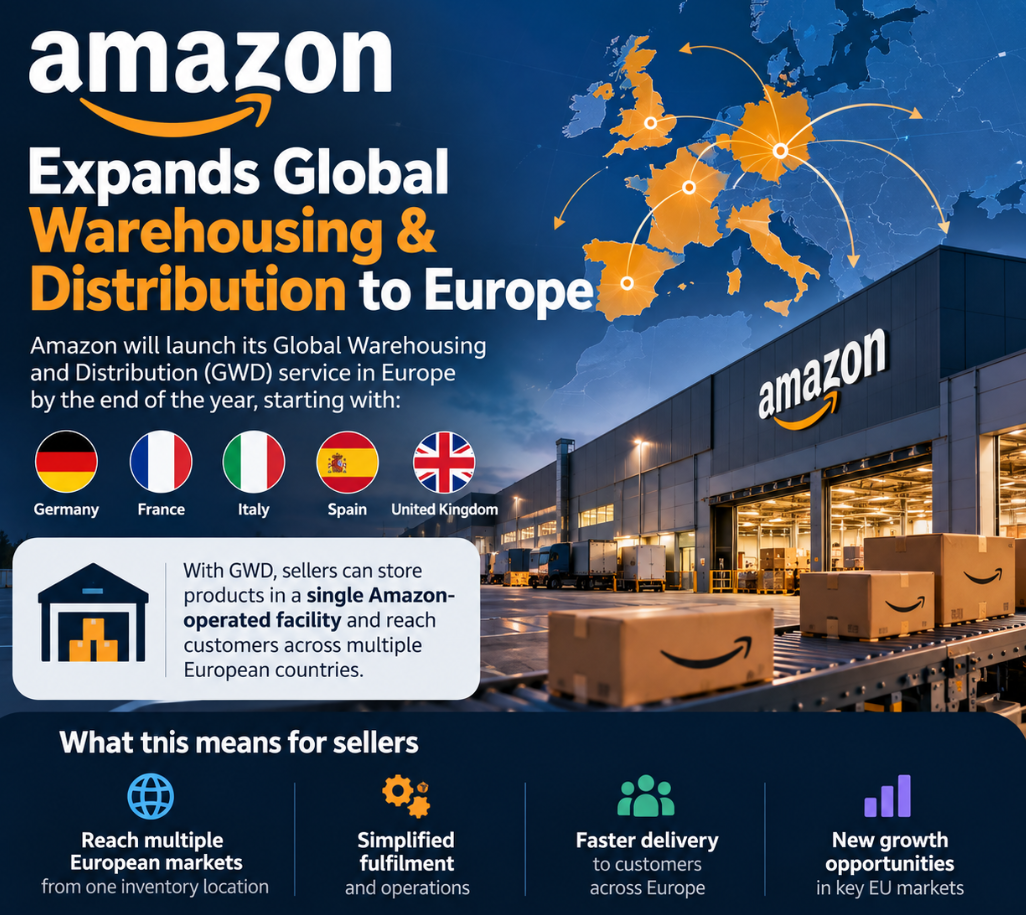
DMSMatrix highlights how Amazon’s planned GWD expansion could simplify inventory management and cross-border fulfilment for international sellers
Amazon is expanding its Global Warehousing and Distribution (GWD) service beyond the United States, with the service set to reach seven additional markets by the end of 2026, including Germany, France, Italy, Spain, the United Kingdom, Japan and Canada.
The expansion introduces a more centralised approach to international inventory management. Instead of sending separate inventory shipments to individual countries, sellers will be able to send a manufacturing run to a single Amazon-operated GWD facility. Inventory can then be allocated across connected markets based on where demand emerges.
For European sellers and international brands, the European rollout will initially cover Germany, France, Italy, Spain and the UK, creating a more integrated route into some of the continent’s largest ecommerce markets.
Moving From Country-by-Country Inventory to a Shared Pool
Traditionally, expanding across multiple European marketplaces can require sellers to forecast demand independently, split inventory between countries and manage separate replenishment requirements.
Amazon’s GWD model is designed to change that dynamic. Products remain in a central inventory pool until demand requires them to be moved into a particular market, after which they can flow into local Fulfilment by Amazon (FBA) centres for customer delivery.
Amazon says that, once the expansion is complete, GWD storage costs could be up to 45% lower than Amazon Warehousing and Distribution (AWD) in the U.S., while replenishment into FBA could be up to five days faster.
The service will operate alongside Amazon’s existing AWD offering, which has already expanded into Germany, France, Italy, Spain and the UK, providing bulk storage and automated replenishment into FBA fulfilment centres.
A Broader Push to Simplify Global Selling
The GWD announcement forms part of a wider set of Amazon initiatives aimed at reducing the operational complexity associated with international expansion.
Amazon says only around 30% of its selling partners currently list products in more than one country. The company also reports that sellers active across multiple countries generate 70% more revenue on average than those selling in a single country.
Alongside GWD, Amazon is introducing tools covering international compliance, listings, supply-chain visibility and seller operations. The company is also developing a “test once, certify many” approach to product compliance, initially focused on toys, with electronics and baby products expected to follow later in 2026.
What It Means for Cross-Border Sellers
The expansion could be particularly relevant for brands looking to enter multiple European marketplaces without committing inventory separately to every destination.
A centralised inventory model can give sellers greater flexibility to respond to changing demand, while reducing the need to make country-by-country inventory forecasts before products are sold.
For sellers, however, marketplace expansion still involves more than fulfilment. Product compliance, VAT and tax requirements, marketplace listings, pricing, inventory visibility, customer service and localised operations remain important considerations when entering new markets.
DMSMatrix Perspective
“International growth is increasingly becoming an exercise in connecting the right marketplaces, logistics infrastructure and operational capabilities,” said Sudeep Singh, President of DMSMatrix.
“Amazon’s GWD expansion is another significant step toward making cross-border fulfilment more flexible. Centralising inventory while allowing it to move according to market demand can help sellers reduce operational friction as they expand across multiple countries. The opportunity now is to connect that fulfilment infrastructure with the broader marketplace, listing and account-management strategy required to scale internationally.”
At DMSMatrix, we help brands and sellers manage the operational complexity of cross-border ecommerce — from marketplace expansion and seller onboarding to listings, inventory, shipping, analytics and account management.
As major marketplaces continue building increasingly integrated international fulfilment networks, the ability to coordinate marketplace presence, inventory and logistics from a unified strategy will become increasingly important for businesses targeting global growth.