







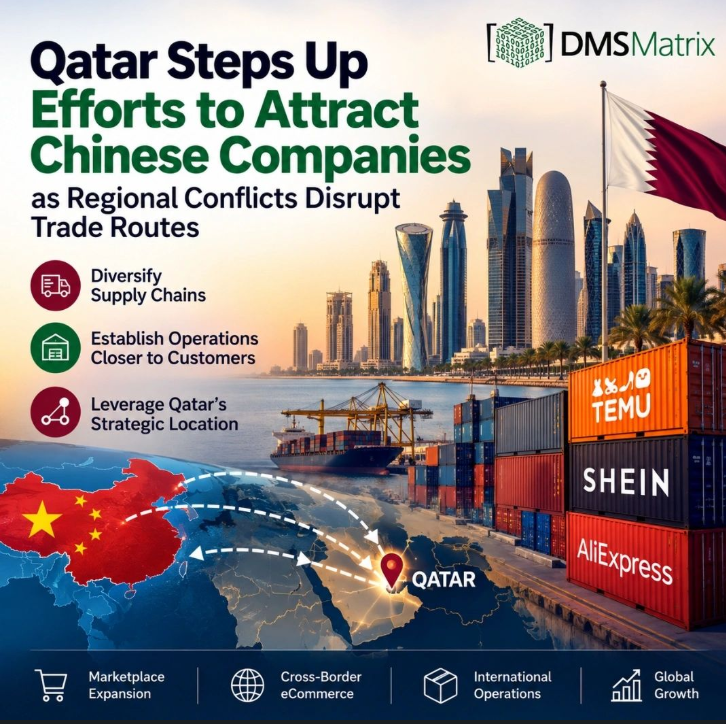
Qatar is intensifying efforts to attract Chinese companies as businesses reassess global supply chains and look for ways to diversify operations closer to key customer markets.
The shift comes amid disruption to trade routes in the Gulf, adding urgency to a broader trend already underway: Chinese businesses are increasingly establishing operations and distribution networks in markets outside mainland China.
“Diversification of supply chain is going ahead anyway, right across the world,” said Sheikh Khalifa bin Salman al-Thani, a member of Qatar’s ruling Thani family and chief executive of Qatar-based logistics solutions company WareOne.
Chinese businesses expand across the Middle East
Chinese companies have expanded their presence across the Middle East in recent years, spanning eCommerce, electric vehicles, technology, logistics and consumer products.
Major online platforms including Shein, Temu and AliExpress have continued expanding their international footprint, contributing to growing demand for regional logistics infrastructure and localized operations.
For Chinese sellers and brands, establishing a presence closer to customers can provide opportunities to shorten fulfillment routes, diversify supply-chain dependencies and respond more efficiently to regional demand.
Qatar seeks a larger role in regional trade
Qatar is positioning itself as another potential hub for international businesses looking to establish operations in the Middle East. Its logistics infrastructure and geographic position make the country part of the wider regional effort to attract international investment and trade activity.
The development also highlights a broader evolution in cross-border commerce: companies are increasingly moving beyond a simple ship-from-origin model toward more distributed regional operations.
For eCommerce businesses, this can mean combining international marketplace access with localized inventory, fulfillment, logistics and customer service.
Implications for cross-border eCommerce
The changing supply-chain landscape could create new opportunities for businesses seeking to enter Middle Eastern markets while maintaining diversified international operations.
At DMSMatrix, we help sellers and brands expand across international marketplaces and manage the operational complexity of cross-border eCommerce — from marketplace listings and inventory to shipping and international growth.
As global trade networks continue to evolve, regionalization, supply-chain diversification and proximity to customers are becoming increasingly important considerations for international sellers.